
 MapleStory 2
MapleStory 2 Imagined an MMO Where Making Things Was the Adventure
Though its official service has ended, MapleStory 2 remains a valuable design case study in housing, music, costumes, minigames, and playful shared spaces.
The block world invited players to leave a mark
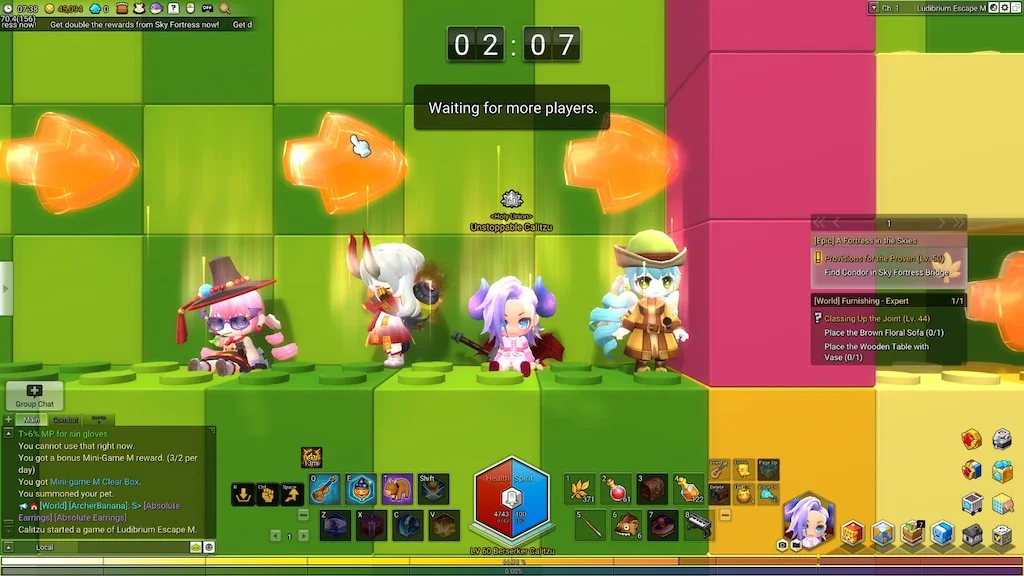
MapleStory 2 translated a familiar series into a three-dimensional world without abandoning its toy-box warmth. Blocks made environments feel constructed rather than merely rendered, which suited a game interested in letting players decorate homes, design clothing, and treat creativity as visible participation.
That visual grammar lowered the distance between official world and player creation. A personalized space or outfit did not feel like an accessory pasted onto a solemn fantasy setting; it belonged naturally inside a bright, assembled world. The game's most memorable identity grew from that permission to make and display.
Music turned spectators into a community
Performance systems gave players a reason to stop moving toward the next reward. Instruments, compositions, and public gatherings transformed towns into stages where the audience was as important as the performer. These moments created social value without requiring combat balance or loot scarcity.
This is difficult for metrics-driven progression to recognize. A concert may not advance a raid tier, yet it can produce the memory that keeps an MMO meaningful. MapleStory 2 understood that shared attention is itself a multiplayer mechanic, and that a world feels inhabited when players can entertain one another.
Playfulness extended beyond the main combat loop
Minigames, housing, exploration, and user designs gave groups multiple ways to spend time together. Friends with different skill levels could still share an evening because the world supported activities other than optimization. Variety softened the pressure to make every login productive.
The combat and gearing game did not always harmonize with that freedom. When progression narrowed toward demanding repetition, the playful social world could feel separated from the systems that governed advancement. The contrast is instructive: offering many joyful activities is not enough if the reward structure teaches players that only a few truly count.
A closed world can still offer an open lesson
The end of official service means MapleStory 2 cannot be evaluated as a live destination. Any retrospective must make that boundary clear. Videos, screenshots, and player memories can document the experience, but they cannot reproduce the population and spontaneous interaction that made its social systems function.
Its design remains relevant because many online worlds still struggle to value creativity beside combat. MapleStory 2 showed how housing, fashion, performance, and small diversions could form a coherent identity. The enduring lesson is not to copy its blocks; it is to let players become part of the world's entertainment.