
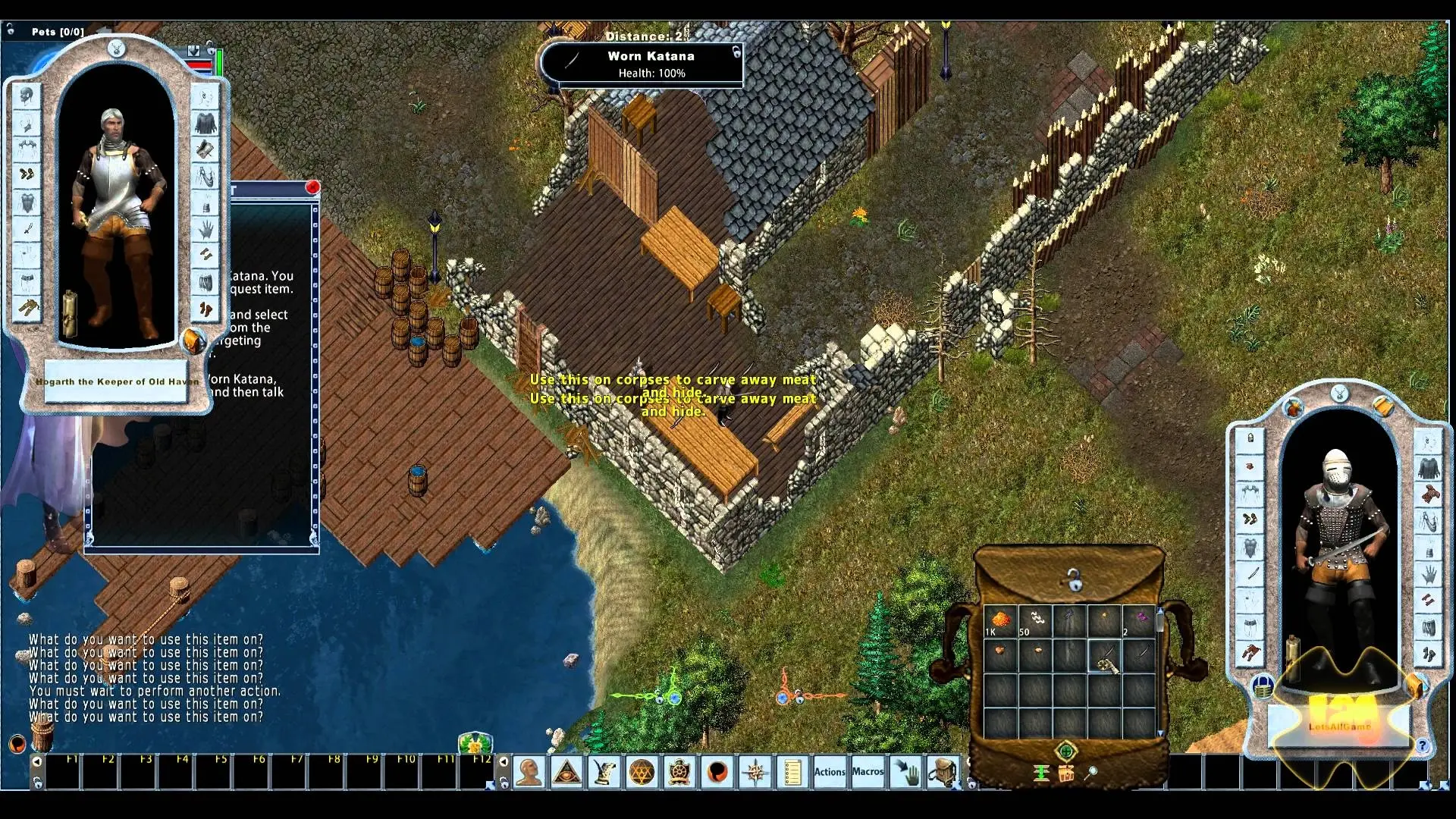
 Ultima Online
Ultima Online Makes Ownership Feel Like Part of the World
Britannia endures because houses, professions, possessions, and reputations feel rooted in a shared place instead of a disposable content season.
A character is a collection of practiced lives
Ultima Online does not need a rigid class label to tell a player who they are. Skills rise through use, so identity emerges from repeated choices: taming animals, shaping metal, casting spells, studying anatomy, or learning how to survive a fight. The result is less like selecting a job and more like slowly becoming known for one.
That freedom makes experimentation meaningful because every template represents a way of living in Britannia. A warrior-blacksmith, treasure hunter, merchant, or animal tamer is not merely a different damage rotation. Each one notices different opportunities in the same landscape and depends on a different part of the player economy.
Housing turns the map into personal history
A house is storage, workshop, storefront, meeting place, and public statement. Decorating one may be peaceful, but acquiring and maintaining a valued location connects a player to the geography and history of a shard. The world feels inhabited because other people have left visible evidence of what they value.
This sense of ownership changes ordinary travel. Roads and coastlines become neighborhoods, player vendors become familiar stops, and returning after a long absence can feel like revisiting a town rather than reopening a menu. Few MMOs make property feel so thoroughly woven into social identity.
The economy gives quiet professions real weight
Crafting matters because players need what specialists produce. Materials pass through gatherers, refiners, artisans, vendors, and adventurers, turning a finished object into the end of a social chain. A successful merchant can build a reputation without treating combat as the only serious form of progress.
The interface and accumulated rules can make that economy difficult to read at first. Yet the friction also preserves local knowledge. Knowing where to shop, which materials matter, and who can make a particular item becomes part of belonging to a shard.
Its age is both the obstacle and the point
Ultima Online carries decades of systems, expansions, visual conventions, and community habits. New players must accept an interface that does not explain itself with modern elegance. The reward is a world whose complexity was not assembled to funnel everyone toward the same endgame checklist.
New Legacy provides a more directed seasonal path, while the established shards preserve the long-form sandbox. Those approaches serve different appetites, but both reveal the same central idea: Britannia becomes memorable when a player has something in it that feels genuinely theirs.