
 Tibia
TibiaTibia: a harsh, legible world where risk gives ordinary progress meaning
Tibia’s simple view hides a demanding economy of knowledge, danger and persistence. Death matters, routes matter, and survival can become a community achievement.
The screen is simple; the decisions are not
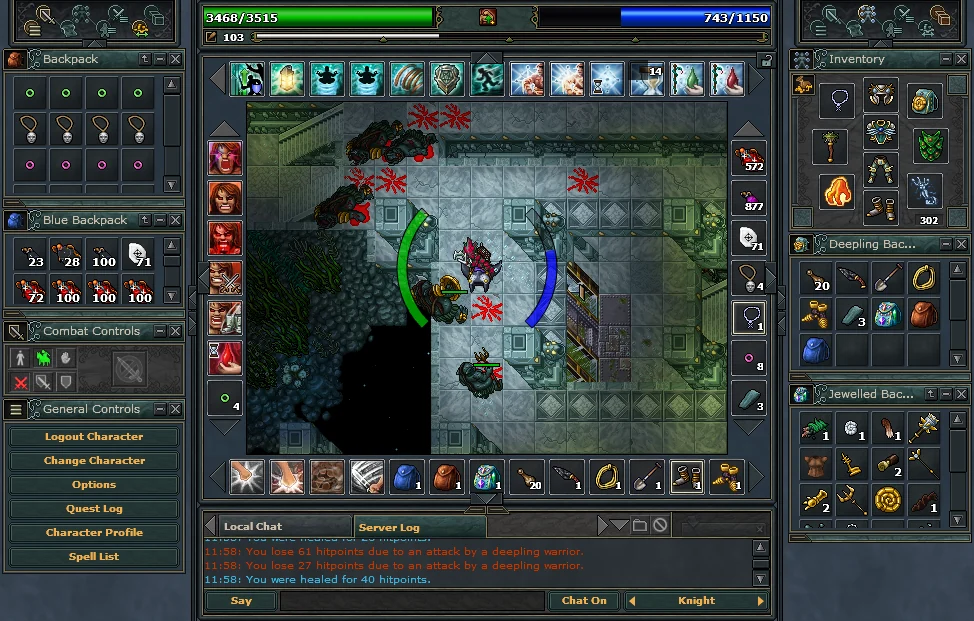
Tibia’s overhead presentation makes the world immediately readable. Tiles, creatures, doors, ladders and terrain communicate function with little cinematic distraction. Beneath that clarity is a dense network of hunting routes, resistances, supply costs, access quests and local dangers. Knowing where to stand or when to leave can matter more than having a dramatic ability animation.
This is a game where information becomes wealth. A player who understands a spawn, carries the correct supplies and knows the escape route can turn danger into reliable progress. Someone with better equipment but weaker judgment can lose far more than the hunt was worth.
Death gives the world a memory
When a character dies, the penalty can include lost experience and skill progress, with blessings and other protections reducing the damage. That consequence changes how players evaluate ordinary movement. A risky shortcut, an unexplored staircase or one extra pull at low resources is not merely a small delay if it goes wrong.
Punishment will not appeal to everyone, but it creates stories from events that other MMOs treat as disposable. Rescue attempts, narrow escapes and preparation rituals become memorable because the outcome matters. The fear is not simulated by a quest marker; it comes from knowing what the character has accumulated.
Vocations establish a practical identity
Tibia’s vocations provide readable combat roles without enclosing the character in an elaborate cinematic kit. Melee durability, ranged damage, healing and offensive magic create different hunting habits and economic pressures. Supplies, positioning and group composition shape what each vocation can attempt safely.
The apparent simplicity helps cooperation. Players understand why another vocation is valuable and how risk is being shared. Solo play remains possible, but social relationships can unlock safer hunts, access to knowledge and recovery when something goes wrong.
The economy is part of every expedition
A hunting session is not judged only by experience. Ammunition, runes, potions and other supplies have costs, while loot has market value and carrying limits. Players choose between speed, safety and profit, turning repeated combat into a small logistical business.
That economy makes preparation meaningful but can encourage optimization that feels like work. The healthiest approach is to define a personal goal before selecting a route. Profit hunting, skill growth, bestiary progress and exploration are different sessions even when they involve the same map.
Server rules define the social climate
Tibia offers worlds with different PvP rules, and that selection determines how much danger comes from other players. The same route can feel like a calculated expedition on one server and a political or territorial risk on another. Population, language and community history also matter.
New players should read the official world types and choose deliberately rather than accepting a default. The harshest version is not automatically the most authentic, and the safest version does not remove the game’s environmental consequences. The right world is the one whose risks produce excitement rather than resentment.
MMOFinder verdict
Tibia demonstrates that visual complexity is not required for a world to feel deep. Its power comes from consequences, accumulated knowledge and the way economic choices follow a character into every dangerous space.
Players who want guided spectacle may see only an old interface. Players who want survival, trade and personal expertise to matter can find a remarkably durable virtual world. Accept the death penalty before admiring the freedom; the two are part of the same design.