
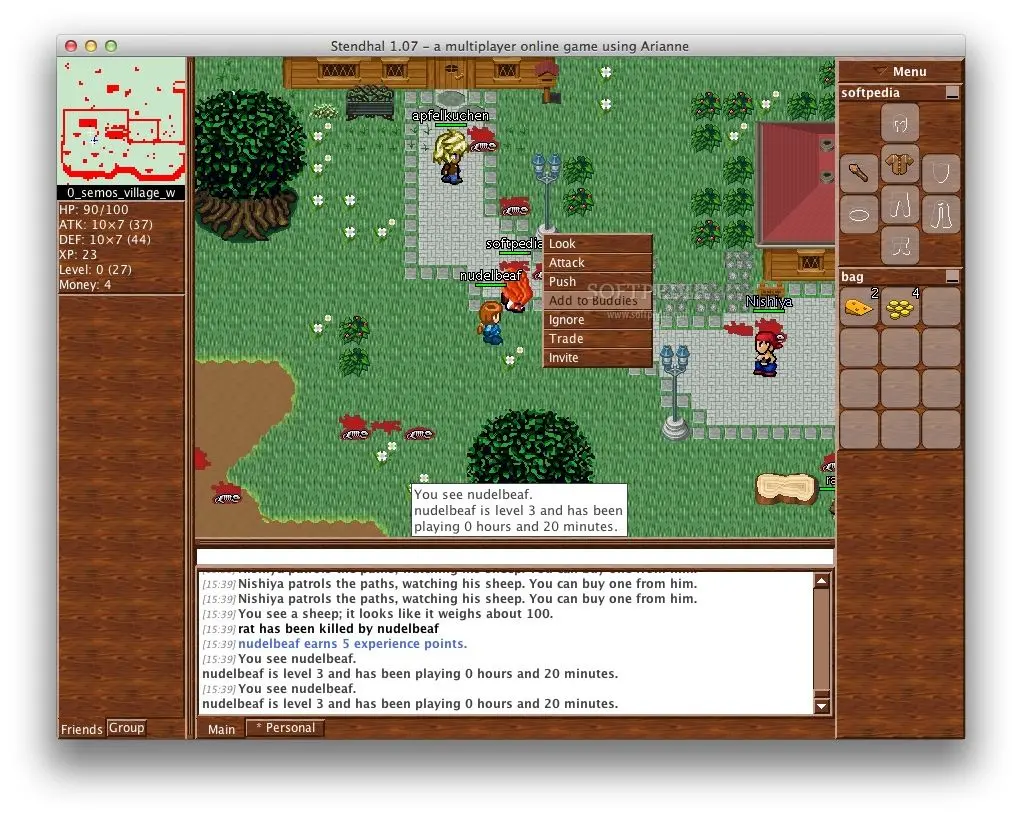
 Stendhal
Stendhal Makes an Open-Source World Feel Handed Down
A vast hand-built map, hundreds of quests, simple combat, trading, community events, browser access, and open development give this old-school world unusual permanence.
The world grows by accumulation
Stendhal does not rush players through a cinematic corridor. Towns, forests, mountains, caves, and dungeons form a broad 2D world whose many small quests reward attention to places and people.
That density feels handcrafted because progress comes from remembering routes, returning to NPCs, and learning where ordinary items become useful. Exploration is less about spectacle than building familiarity.
Quests make kindness part of progression
Tasks range from defending people and fighting monsters to feeding the hungry, healing the sick, solving puzzles, and delivering help. Experience and equipment matter, but the variety keeps heroism from becoming only a count of defeated enemies.
The writing and presentation vary across years of community development. That unevenness is also evidence of a world built through many contributions instead of one tightly controlled content pipeline.
Open source changes who can shape the game
The client, server, and project are openly developed. Players with technical or creative skills can inspect the machinery, report problems, contribute improvements, and understand that the game belongs to a continuing collaborative effort.
Contribution is not required to play, yet it changes the relationship between community and developer. Stendhal can survive because knowledge is shared rather than locked behind a vanished studio.
Simplicity leaves room for community
Browser and downloadable clients make entry easy, while direct combat, trading, chat, and recurring events provide reasons to meet. The modest visuals keep hardware requirements low and the rules readable.
Players expecting polished animation or guided endgame structure may find the pace austere. Those who value continuity can discover something rarer: a friendly world that has grown without needing to reinvent itself every season.