
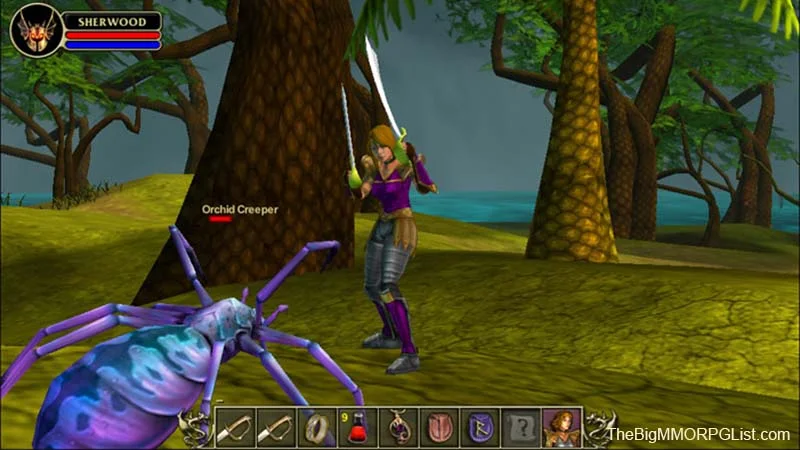
 Sherwood Dungeon
Sherwood Dungeon Makes an Endless Descent a Social Landmark
Thirteen islands, an infinitely deep dungeon, real-time skill combat, clans, raids, open-world PvP, pets, mounts, transformations, and cross-platform play preserve a singular indie MMO.
The dungeon is a direction without an ending
Sherwood Dungeon gives players a simple shared question: how far down can the expedition go? An infinitely deep dungeon turns each level into a waypoint rather than the final authored destination.
The premise makes repetition understandable. Greater depth promises stronger opposition and more loot, while the shared descent gives parties an easy reason to form.
Combat rewards timing over button volume
Attacks and defenses are entered in real time, and careless aggression can leave a character exposed. Patience, reaction, and reading an opponent matter against monsters as well as players.
The control scheme remains approachable enough for mobile and desktop users to share a world. Hidden depth comes from using a small vocabulary well rather than managing several crowded hotbars.
Identity can change without losing progress
Players can switch avatars, collect heroes, transform into creatures, gather pets and mounts, and craft weapons with runes and scrolls. Appearance stays playful without forcing a new progression track for every fantasy.
That flexibility supports a social space where experimentation is visible. It also reflects years of accumulated systems whose presentation may not always explain itself gracefully.
An indie world survives through continuity
Thirteen islands, clans, player raids, duels, chat, and open-world battles give the dungeon a broader community context. Cross-platform access helps a modest population meet in the same places.
Sherwood cannot match the production scale of a contemporary blockbuster. Its value is consistency: a recognizable world, direct combat, and a communal dungeon that has remained understandable across generations of browsers and devices.