
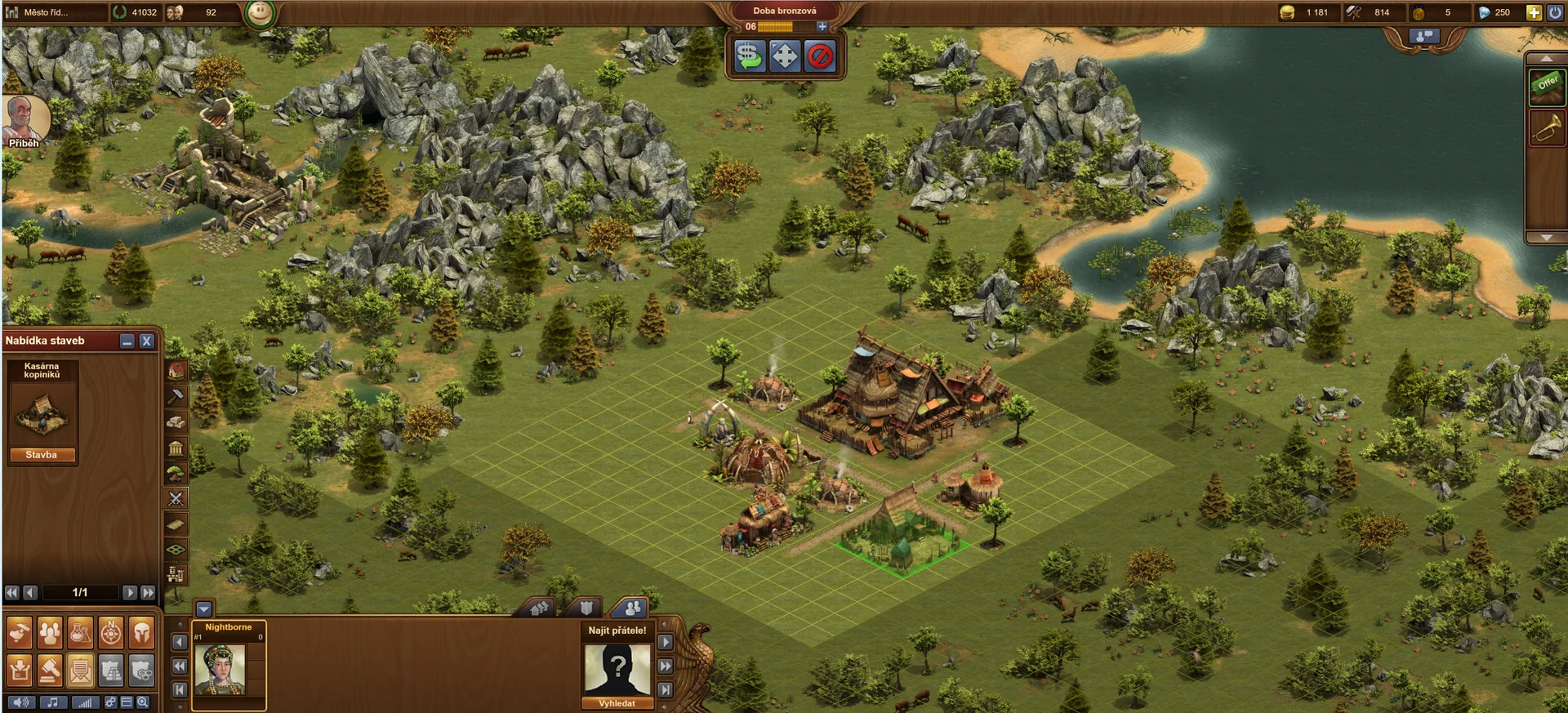
 Forge of Empires
Forge of Empires Turns a City Into a Calendar of Compromises
Era advancement, spatial planning, production timers, negotiation, tactical battles, and guild competition make every expansion a choice about limited land and attention.
Every building competes for the same ground
Forge of Empires gives production, population, happiness, military, goods, roads, and special buildings physical footprints inside one constrained city. A useful reward is not automatically useful if it cannot fit without disrupting everything around it.
Layout becomes a continuing argument between immediate output and future flexibility. Rebuilding is normal. The satisfying moments come when a redesigned district removes wasted roads or lets several bonuses support the same cluster of structures.
Advancing an age is not simply leveling up
Research opens technologies, buildings, units, and a new visual era, but advancement also changes costs, opponents, goods, and expectations. Moving forward before the city is prepared can exchange novelty for prolonged inefficiency.
The decision gives progression weight. A patient governor stockpiles resources and plans replacements, while an eager one accepts friction for faster discovery. Neither approach is purely correct because the city reflects the owner’s tolerance for delay and rework.
Conflict offers more than one language
Province encounters and recurring activities often allow military combat or negotiation. Tactical battles reward unit matchups and positioning, while negotiation consumes goods and tests deduction under limited attempts.
This flexibility lets economic cities participate without copying a pure military build, though each route has costs. Guild Expeditions and Battlegrounds then turn those personal capabilities into collective power and shared rewards.
The calendar can overtake the city
Production timers, incidents, events, expeditions, battlegrounds, and recurring collections provide frequent reasons to return. Used lightly, they create a comforting rhythm of small improvements. Pursued completely, they can make the game feel like a schedule that happens to contain a city.
Long-term enjoyment depends on choosing which opportunities to ignore. Forge of Empires offers more tasks than any one city needs. The player’s most important optimization may be deciding what deserves attention.