
 EverQuest II
EverQuest II: a magnificent MMO archive with a difficult front door
Norrath remains one of the richest places to live, craft and build in an MMO, but newcomers must learn to navigate more than two decades of accumulated systems.
A world that feels accumulated, not assembled
EverQuest II no longer feels like a single campaign with a clean beginning and end. It feels like an inhabited archive. Norrath has been expanded, revised and layered for more than two decades, leaving behind an enormous range of zones, quest lines, dungeons, systems and eras. That scale is the game’s defining advantage, but it also explains why a new account can feel as if it has entered a conversation already in progress.
The appeal is not simply the amount of content. It is the sense that characters can develop lives rather than follow one prescribed track. Adventuring, collecting, crafting, decorating, mentoring, guild projects and alternate advancement all compete for attention. Players who enjoy choosing their own long-term projects can treat the game as a persistent hobby instead of a sequence of seasonal checklists.
The strongest reason to play is life beyond combat
Housing is still one of EverQuest II’s clearest advantages. Homes and guild halls are not merely trophy rooms with a few fixed hooks. The placement system supports scaling, rotation, construction and elaborate custom spaces built from ordinary objects. The official site has highlighted the decorating community for years, and that culture remains central to the game’s identity.
Tradeskills are similarly substantial. Crafting uses active abilities, dedicated professions, equipment, quest lines and its own progression. It can support adventuring, but it also works as a separate reason to log in. That distinction matters: many MMOs contain crafting, while EverQuest II makes room for players who primarily identify as crafters, decorators, collectors or guild organizers.
Traditional class identity still carries weight
EverQuest II comes from a design tradition in which class choice is meant to shape a character’s social role. Its large roster divides fighters, priests, scouts and mages into more specialized identities, with tanks, healers, damage dealers and utility classes bringing different tools to a group. That can make coordinated play more satisfying than systems where every class is broadly self-sufficient.
The tradeoff is that the game does not always teach those responsibilities gracefully. Fast leveling, old encounter assumptions and years of alternate-advancement choices can produce a capable-looking character before the player understands how it should perform. Veterans may see flexibility and depth where a newcomer sees several overlapping layers of unexplained decisions.
Two decades of growth created a difficult front door
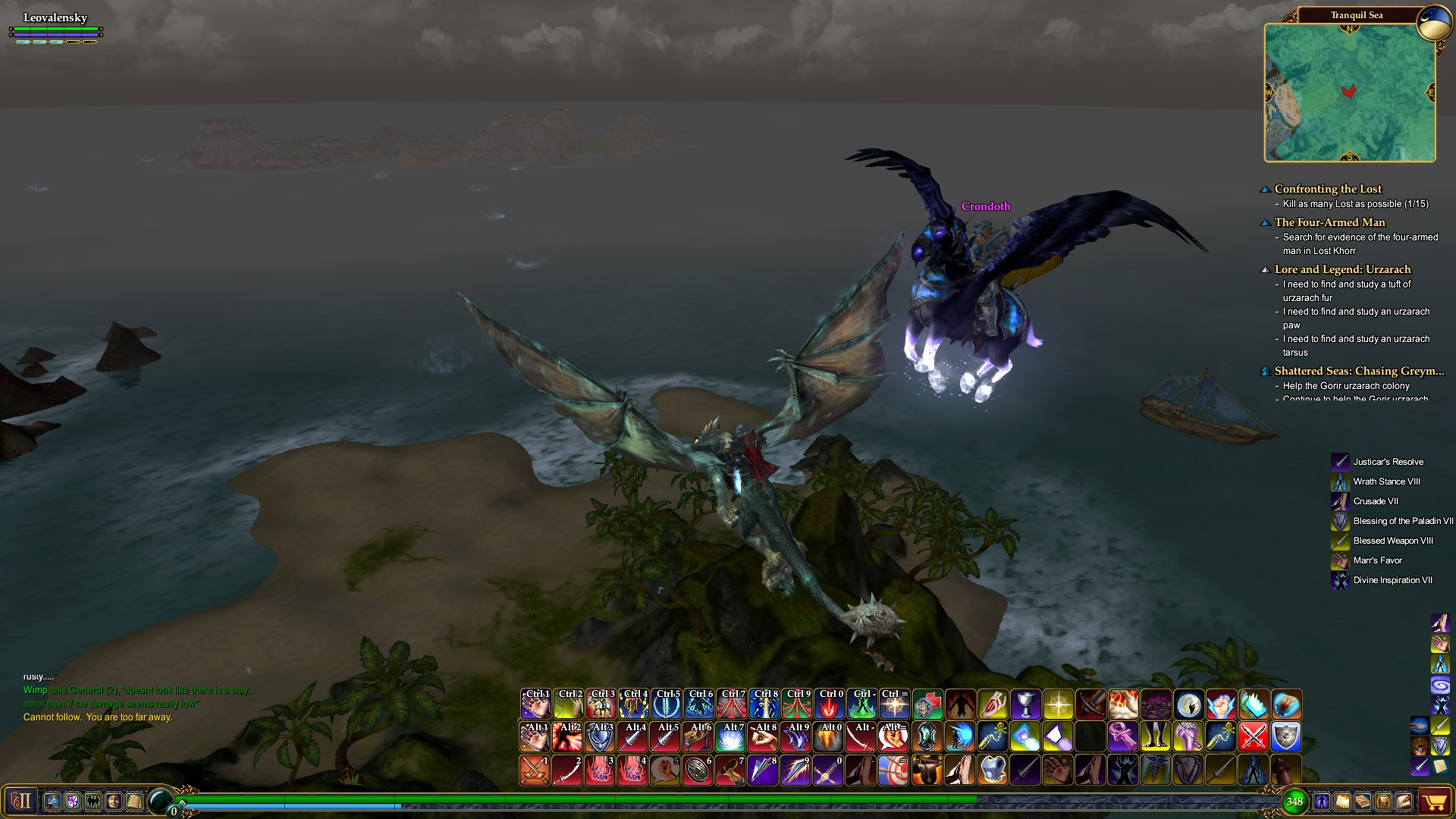
The first hours are the weakest part of the recommendation. The interface is dense, visual feedback can feel dated, and item statistics quickly become more complicated than the early encounters require. Older content often assumes knowledge that was learned gradually by a busy leveling population. A new player may move through those zones largely alone or outlevel them before understanding why their mechanics mattered.
That does not make the game inaccessible, but it changes the best approach. EverQuest II rewards deliberate onboarding: choose a server for a reason, learn one class rather than chasing the fastest level gain, join a helpful guild, and treat outside guidance as part of the experience. Players expecting the game to provide a modern guided tour may encounter friction long before reaching the systems that make Norrath special.
Free entry does not make every path equivalent
The official site allows players to download and begin for free, which makes experimentation easy. However, free access should not be confused with identical access. Daybreak’s membership page lists benefits involving broker access, spell ranks, chat, guild functionality, housing and guild halls, progression servers and other conveniences or restrictions. Expansion purchases and individual server rules add further distinctions.
The practical advice is to decide what kind of player you expect to become before spending heavily. A curious explorer can learn a great deal through free access. A committed trader, progression-server player or endgame-focused character may value membership much sooner. MMOFinder treats those as separate decisions because the most important limitation depends on the activity you care about.
Choosing the right version of Norrath matters
Live servers offer the broadest accumulated version of the game, but they also expose the full weight of its history. Time-Locked Expansion servers provide a different entry point by limiting or sequencing content around earlier eras, sometimes adding special loot, trade or character rules.
A progression server is not automatically simpler, and its population or unlock schedule can change the experience. Still, choosing between live and time-locked play is more consequential than selecting a server name at random. The right ruleset can determine whether old zones feel like empty history or shared group content.
MMOFinder verdict
EverQuest II is not the easiest classic MMO to sample casually, but it remains one of the most interesting to inhabit seriously. Its age is visible in the interface, combat presentation and onboarding. Its age is also the source of its extraordinary breadth: a mature housing culture, meaningful tradeskills, specialized classes, a huge world and multiple ways to revisit earlier eras.
The recommendation depends on what you want from an MMO. If you want a polished path that constantly tells you what matters next, Norrath may feel exhausting. If you want a persistent fantasy home with enough history and systems to support years of self-directed projects, the difficult front door can lead somewhere few newer games attempt to build.