
 Dungeons & Dragons Online
Dungeons & Dragons Online: the MMO where the dungeon is the main character
DDO trades a seamless open world for traps, narrated adventures, flexible builds and repeatable difficulty—an unusual MMO that feels closest to a cooperative campaign night.
Adventures feel designed, not generated
DDO’s strongest idea is that a dungeon should be more than a hallway between combat rooms. Quests use levers, traps, hidden passages, optional objectives, vertical spaces and narrated scene-setting to create the texture of a tabletop module. Even familiar environments can ask the party to split, search, protect an objective or notice a clue.
That authored density makes the game unusually satisfying for a regular group. Players can learn a quest together, discover an optional route and gradually raise the difficulty. The world between adventures is less convincing than in a broad exploration MMO, but the instances themselves carry personality and purpose.
Character building is both the reward and the risk
Classes, ability scores, feats, skills, spells, enhancements, gear and multiclass combinations give DDO a wide construction space. A character can express a specific fantasy rather than merely select a preset combat kit. The same class can feel different depending on weapon style, defenses, spell choices and the point at which another class is added.
Freedom also creates traps. Choices that sound thematic may interact poorly, and a build that cruises through early adventures can struggle when defenses, accuracy or saving throws begin to matter. New players benefit from following a tested first-life plan, then experimenting after they understand the game’s numerical language.
Action combat rewards awareness over spectacle
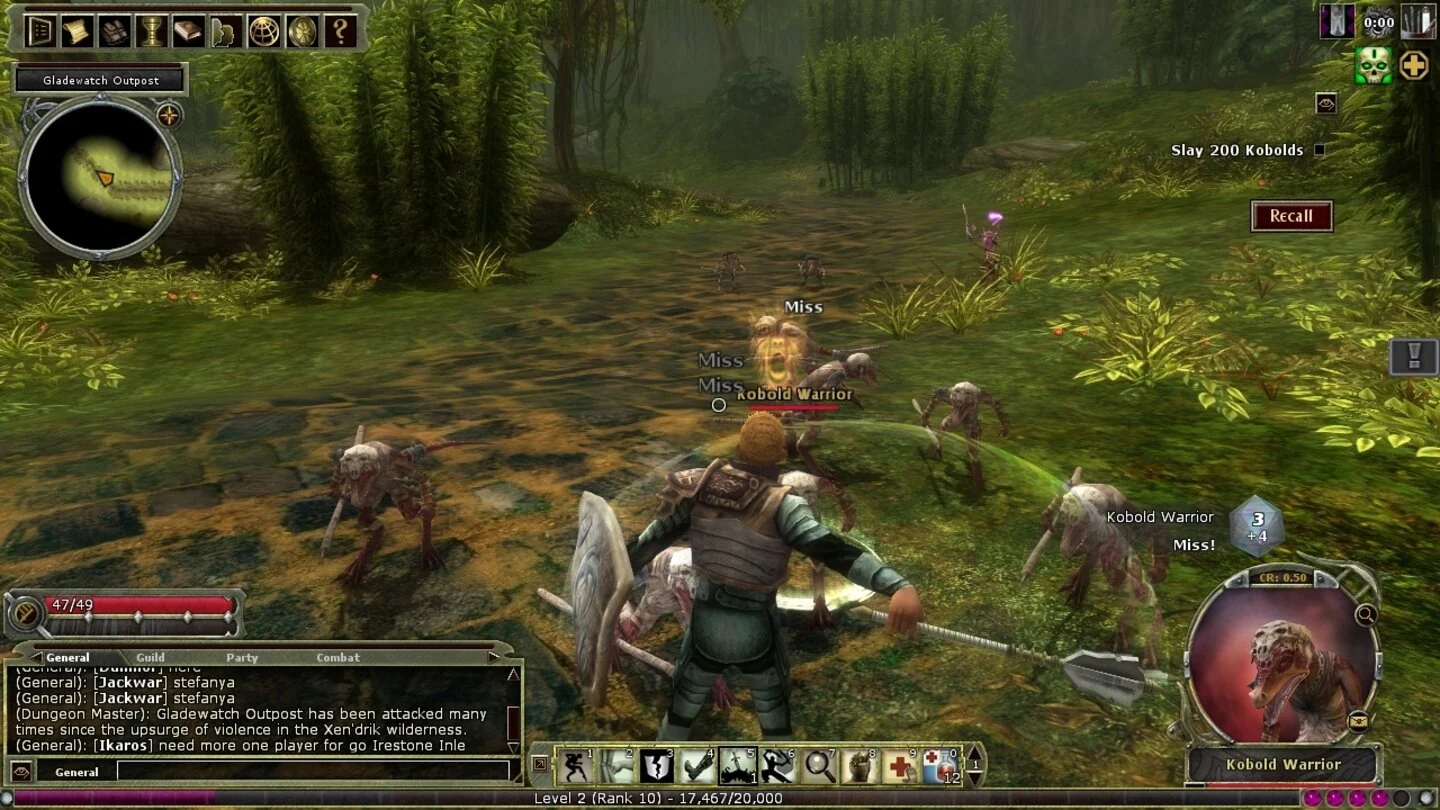
Movement, blocking, aiming, positioning and environmental hazards give fights more physical presence than a traditional tab-target MMO. The game is not a modern character-action spectacle, but attacks connect to space. A doorway can become a defensive tool, a trap can change the pull, and a mobile enemy can disrupt an otherwise tidy plan.
Older animation and collision behavior sometimes make that action feel rough. Latency and dense effects can obscure what happened, especially on demanding difficulty settings. Even so, the combination of active movement and tabletop-style statistics gives DDO a combat identity that has not been widely copied.
Difficulty is a way to reread content
Adventures can be repeated at higher settings for better rewards and greater danger. This changes familiar rooms because enemy damage, defenses, traps and special threats demand tighter play. Reaper difficulty extends that idea for experienced groups, turning known quests into tests of preparation and coordination.
Repetition is central rather than incidental. Players who want every session to reveal a new map may tire of the loop, while players who enjoy mastering a module can find real depth. Knowing where danger lives does not trivialize a quest when the selected difficulty leaves little room for error.
Reincarnation turns an ending into another build
Reincarnation lets an established character begin again and carry forward forms of permanent progress. It creates a long horizon built around revisiting levels with new classes, races or goals. The system fits DDO because the game’s authored adventures support mastery and because character construction is compelling enough to repeat.
It can also make the community difficult to read. A low-level character may belong to a veteran with extensive account power and perfect route knowledge. Public groups can rush past dialogue, secrets and optional encounters. New players should not mistake that speed for the only valid way to play; a first journey is often better when allowed to breathe.
MMOFinder verdict
DDO is less a virtual country than an enormous shelf of cooperative modules. That narrower focus is its strength. Traps matter, builds matter, difficulty matters, and a practiced party can feel like a tabletop group that has learned how each member thinks.
Come for authored dungeons and character engineering, not for a seamless world or effortless onboarding. The game rewards players who read, plan and repeat with purpose, especially when they bring friends who agree to explore rather than sprint.