
 Crossout
Crossout Makes Engineering as Lethal as Aim
Modular vehicles, destructible parts, faction hardware, crafting, and a player market turn every battle into a test of the machine built before it.
The first battle happens in the garage
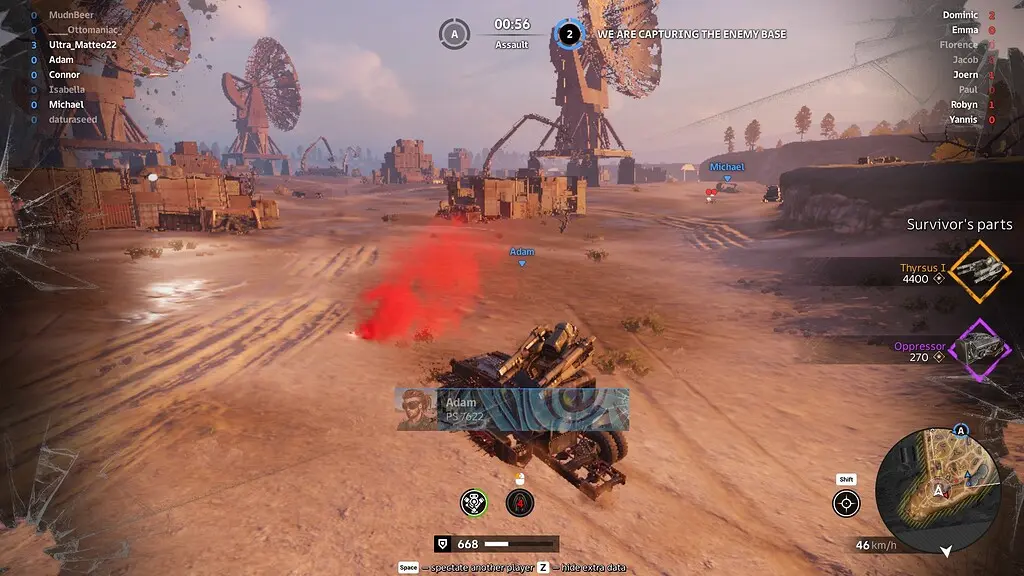
Crossout asks players to assemble a fighting machine from cabins, frames, movement parts, weapons, generators, modules, and armor. Every piece consumes mass, energy, space, or power score, so visual imagination must eventually answer to engineering limits.
The garage is not separate from combat; it is where combat choices become physical. A low weapon may survive longer but lose firing angles. An exposed generator saves space but can turn one accurate shot into a catastrophic explosion.
Damage dismantles the plan in real time
Individual parts can be shot away. Losing a wheel changes steering, losing a weapon removes an attack option, and stripped armor exposes the cabin beneath it. Enemies are machines to diagnose rather than health bars to empty.
This makes aim tactical. A weaker vehicle can create an advantage by removing movement or firepower instead of trading raw damage. Good pilots also learn to keep a damaged build useful after its original symmetry has disappeared.
Factions are libraries of mechanical ideas
Progress with wasteland factions opens parts built around different identities: speed, melee aggression, armor, heavy firepower, technology, or improvised utility. Advancement expands the design vocabulary rather than merely increasing one statistic.
More options create deeper invention but also a formidable collection problem. Veteran garages contain counters and specialized tools that newcomers lack. Learning which part solves a design problem is as important as obtaining it.
The market turns wreckage into opportunity
Battles award resources used for crafting, while many parts can be bought and sold through a player-priced market. A builder can grind materials, manufacture desirable components, trade around demand, or spend directly to accelerate the garage.
That economy gives spare parts purpose, though it also keeps attention on efficiency and scarcity. Crossout is most satisfying when the next acquisition enables a new experiment—not when every match is reduced to the price of reaching the current competitive template.