
 MMOFinder editorial
Anarchy Online Makes Character Building Feel Like Science Fiction
Anarchy Online's professions, implants, nanoprograms, equipment requirements, and generated missions turn Rubi-Ka into a laboratory for ambitious builds.
Progression is a puzzle of requirements
Anarchy Online treats equipment as something to engineer onto a character rather than simply wear after reaching a level. Abilities, implants, buffs, and profession tools interact through requirements that can be manipulated by careful planning. Equipping a desired item may become a project involving several temporary steps.
This creates a powerful feeling of authorship. A successful build is not only loot obtained; it is a solution the player designed. The cost is opacity. Without current guides or experienced help, the number of skills and dependencies can make even an early decision feel dangerously permanent.
Professions express different kinds of intelligence
The profession roster covers straightforward soldiers and martial artists alongside engineers, bureaucrats, traders, fixers, nanotechnicians, and other roles with unusual utility. Differences are not limited to damage color. Pets, crowd control, economic advantages, mobility, healing, and nanoprograms create distinct relationships with the world.
That variety makes group composition interesting because value is distributed across combat and preparation. A profession can matter through buffs, access, construction, or control before the first attack. Players who enjoy being useful in indirect ways have more room to build an identity than many modern role templates allow.
Mission terminals make Rubi-Ka feel procedural
Generated missions offer a practical answer to the persistent-world problem of finding something appropriate to do. Players can select jobs, adjust parameters, travel to the target, and complete an instanced objective alone or with a team. The loop gives short sessions a clear shape without erasing the larger world.
Repetition is unavoidable, and the layouts can reveal their procedural nature. Yet mission terminals reinforce the setting's corporate machinery: work is assigned, risk is calibrated, and the character enters another facility in search of credits or equipment. System and fiction support one another.
Rubi-Ka rewards archaeological patience
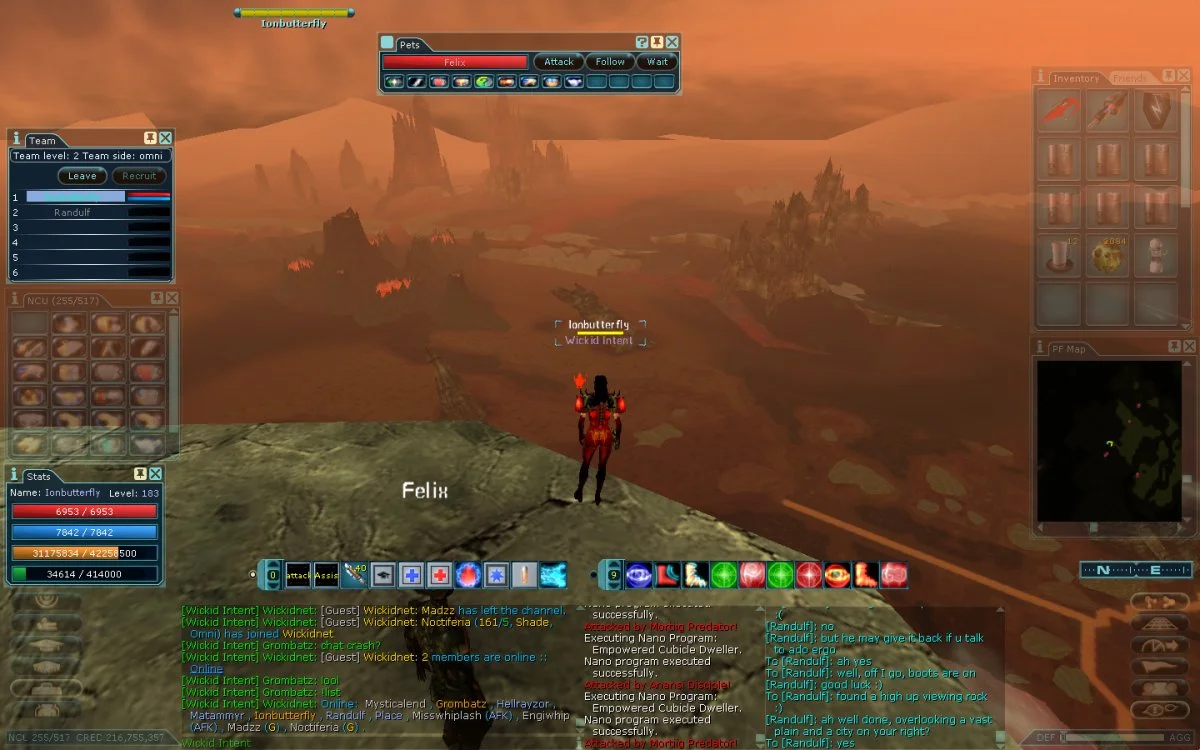
The game's greatest barriers are visible immediately. Controls, menus, visual presentation, and onboarding belong to an earlier design culture. Important knowledge often lives in community resources rather than the client, and a newcomer may need help before understanding why a veteran considers a particular setup elegant.
For players willing to perform that archaeology, Anarchy Online remains unusually rich. It imagines science-fiction progression as manipulation of bodies, technology, and information. The satisfaction comes from turning an intimidating ruleset into a character that could only exist because the player learned how the machine works.