
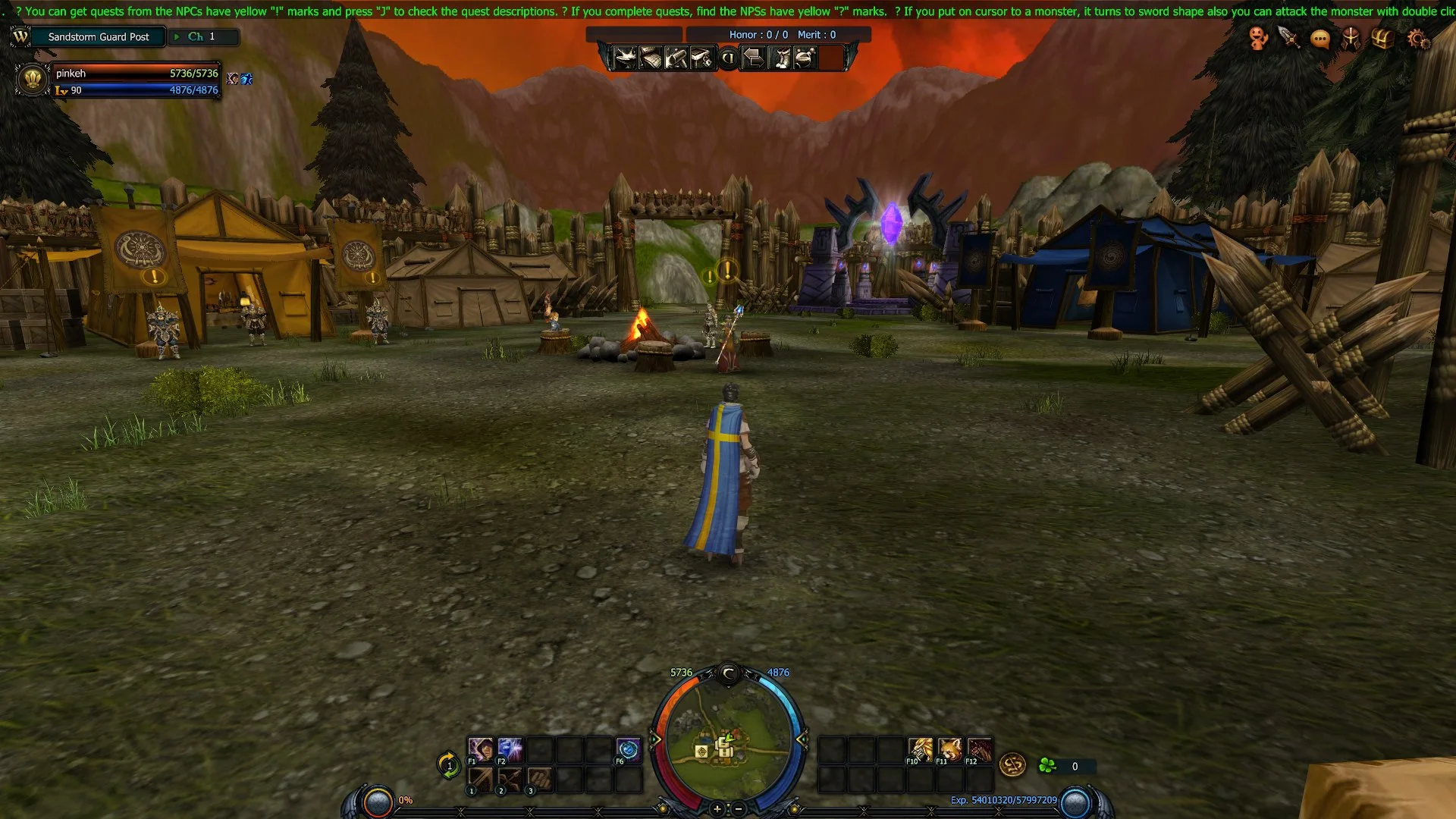
 4Story
4Story Builds Its Fantasy Around a War That Never Quite Ends
4Story connects familiar class progression to kingdoms, mission zones, territorial conflict, and guild coordination in a world defined by contested allegiance.
The kingdoms give routine progression a destination
4Story begins with the recognizable language of fantasy MMORPGs: classes, quests, monsters, equipment, and guilds. Its identity emerges when those systems are placed inside a conflict between kingdoms. A character is not merely growing stronger for private completion; that strength eventually belongs to a side.
Valorian and Derion provide the central opposition, while Gor complicates the political background as a kingdom trying to preserve its position between rivals. The arrangement gives the world a reason for recurring war and lets ordinary advancement feel connected to a public struggle.
Mission zones turn leveling space into contested space
Mission areas bring progression and conflict into the same geography. Players entering for experience or rewards may also encounter the rival kingdom, so an efficient route can become a battlefield without waiting for a separate competitive queue. The danger makes otherwise repeatable activity less predictable.
That overlap is most exciting when populations are balanced and groups are active. It can be punishing when one side dominates or a newcomer lacks support. The design assumes that faction membership will eventually become a social network rather than remain a character-creation label.
Guilds convert attendance into battlefield strength
Territory battles and scheduled wars reward players who can arrive together, understand roles, and respond to direction. A guild supplies the organization needed to transform individual characters into a force capable of holding objectives. Leadership matters because numbers without coordination can still fail.
The same structure gives repeated gearing a visible purpose. An upgrade is not only a larger statistic for the next dungeon; it can improve survival during a push or help finish a contested target. Players who need social context for long progression loops are more likely to appreciate that connection.
Its clarity survives the dated machinery
4Story does not disguise its legacy foundations. Movement, combat feedback, interface density, and quest structure can feel stiff beside newer games. Long-running progression also leaves a substantial distance between a fresh character and established competitors.
What remains readable is the central promise: choose a kingdom, build a character, find a guild, and participate in a war larger than one match. For players who value that classic arc, the simplicity can feel focused rather than empty.